

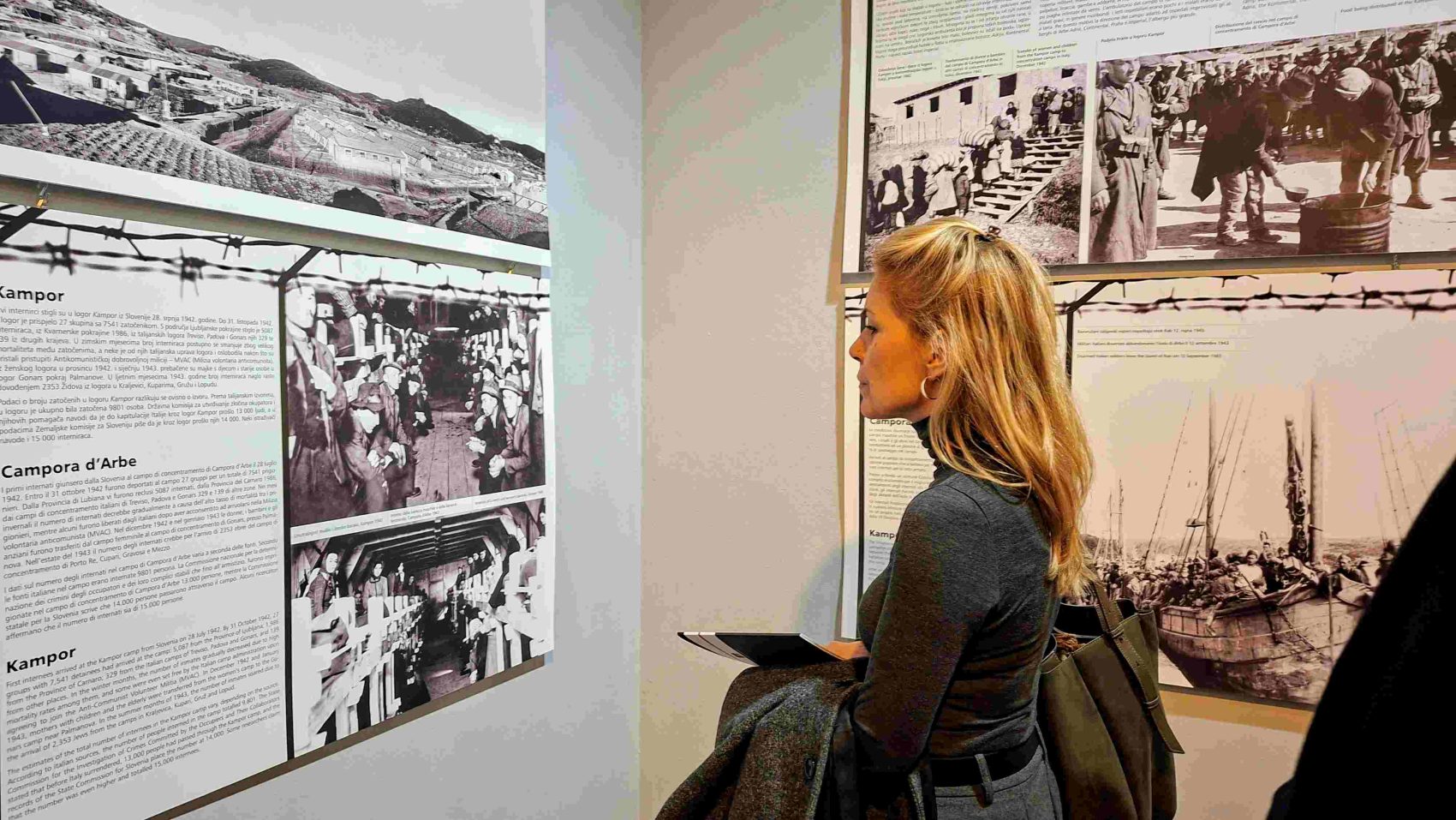
The exhibition is presented to mark Holocaust Remembrance Day. Following the defeat of the Kingdom of Yugoslavia in the April War of 1941, the country disappeared from the map of Europe. In the occupied territories of the Croatian Littoral and Gorski Kotar, the Italian occupying authorities established their own civil administration. On 28 April 1941, Temistocle Testa, Prefect of the Province of Fiume, appointed civil commissioners for Kastav, Sušak, Crikvenica, Novi, Senj, Krk–Rab, Čabar–Delnice, Ogulin–Vrbovsko and Karlovac.This territory was annexed to the Province of Fiume, while in the remaining parts of the Croatian Littoral and Gorski Kotar, control over the civil administration was left to the Ustaša-led Independent State of Croatia (NDH). The Italian authorities sought to Italianise the occupied territory as rapidly as possible. The methods of Fascist denationalisation and assimilation of the non-Italian population, developed between the two world wars in the newly annexed territories of Istria and Fiume, were also applied in the annexed parts of the Croatian Littoral and Gorski Kotar. From the very beginning of the occupation, the local population began to organise resistance to Fascism and denationalisation. The first Partisan units were formed in the forests of the Croatian Littoral and Gorski Kotar in July and August 1941. As these units grew in strength and activity, the occupying authorities attempted to suppress them through increasingly severe repressive measures, which escalated into terror against the civilian population. As early as 1941, collection camps were established for internees from the annexed territories of the Croatian Littoral, Gorski Kotar and Slovenia. Within the territory of today’s Primorje-Gorski Kotar County, the Italian occupying authorities established four concentration camps: Lovran, Bakar, Kraljevica and Kampor. During the 22 months in which these camps operated, approximately 23,000 people were interned in concentration camps in the Croatian Littoral, including Slovenes, Croats, Serbs and Jews. More than 3,000 of the internees were children under the age of sixteen. Of the several thousand people who died in the camps, 95 per cent of the deaths occurred at the Kampor concentration camp on the island of Rab. The concentration camp in Lovran was closed on 1 March 1943, and the camp in Bakar at the end of July 1943. The camps in Kraljevica and Kampor were dissolved following the capitulation of Italy on 8 September 1943. The exhibition was organised in cooperation with the Jewish Community of Rijeka and the Croatian Cultural Centre in Sušak (HKD). It is based on Mladen Grgurić’s book Italian Concentration Camps in the Croatian Littoral, 1941–1943, adapted for the exhibition by Vesna Rožman and Sabrina Žigo.
The exhibition is on view in the atrium of the Croatian Cultural Centre in Sušak from 27 January to 9 February 2026.

