

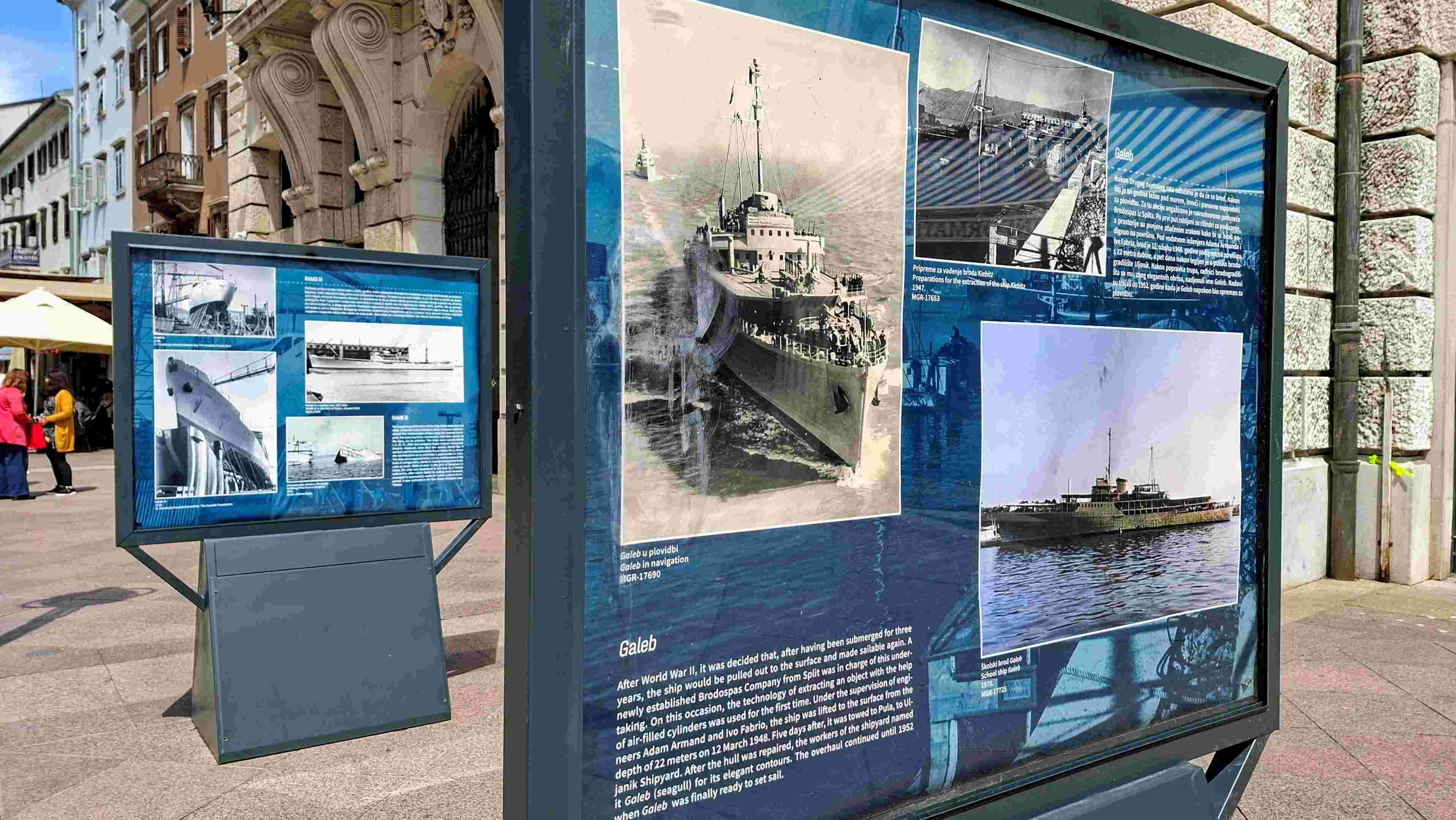
As part of the programme marking the 80th anniversary of the liberation of Rijeka from Fascism, the exhibition The Ship Galeb, organised by the City Museum of Rijeka and the City of Rijeka, has been installed on Korzo. Conceived as a chronological overview, the exhibition traces the rich and complex history of this legendary ship. While work continues on completing its restoration and installing the permanent museum exhibition, the exhibition presents more than just the biography of Galeb: it also introduces the main themes that will form the backbone of its permanent display. The story of the ship begins in 1938, when the Kingdom of Italy commissioned four vessels to transport bananas from its colonies, among them RAMB III. At the beginning of the Second World War, the ship was converted into an auxiliary cruiser. Following the capitulation of Italy in 1943, it was taken over by the German Navy, converted into a minelayer and renamed Kiebitz. Within six years, the ship suffered serious damage twice: first when a torpedo struck its bow in the Libyan port of Benghazi, and again when Allied aircraft bombed it in the port of Rijeka, where it remained submerged for three years. In 1948, after the Brodospas company raised it from the seabed, the ship was given a new name and began a new chapter in its history. Until the breakup of Yugoslavia, it served two important roles. As a training ship of the Yugoslav Navy, Galeb sailed around the world, completing more than 30 voyages during which many future naval officers received their training. But Galeb was more than a training ship. It also became the floating residence of Josip Broz Tito. In this role, the ship served as a stage for political and diplomatic activity during 14 voyages to 18 countries. Galeb hosted important talks with heads of state, presidents and prime ministers, and became one of the places where the course of Yugoslavia and the Non-Aligned Movement was shaped. Following the breakup of Yugoslavia, Galeb was moored in Montenegro. In 2000, it was purchased by Greek businessman John Paul Papanicolaou, who planned to convert it into a luxury yacht. Following his bankruptcy, however, the ship was left abandoned at the Viktor Lenac Shipyard. In 2006, Galeb was designated a protected cultural asset of the Republic of Croatia, and the City of Rijeka subsequently purchased the ship with the aim of converting it into a museum. The exhibition was created by Franka Toljanić, with Danijela Pintur, Josipa Verbanac and Deborah Pustišek Antić as collaborators.
The exhibition is on view on Korzo from 7 to 17 May 2025.

