

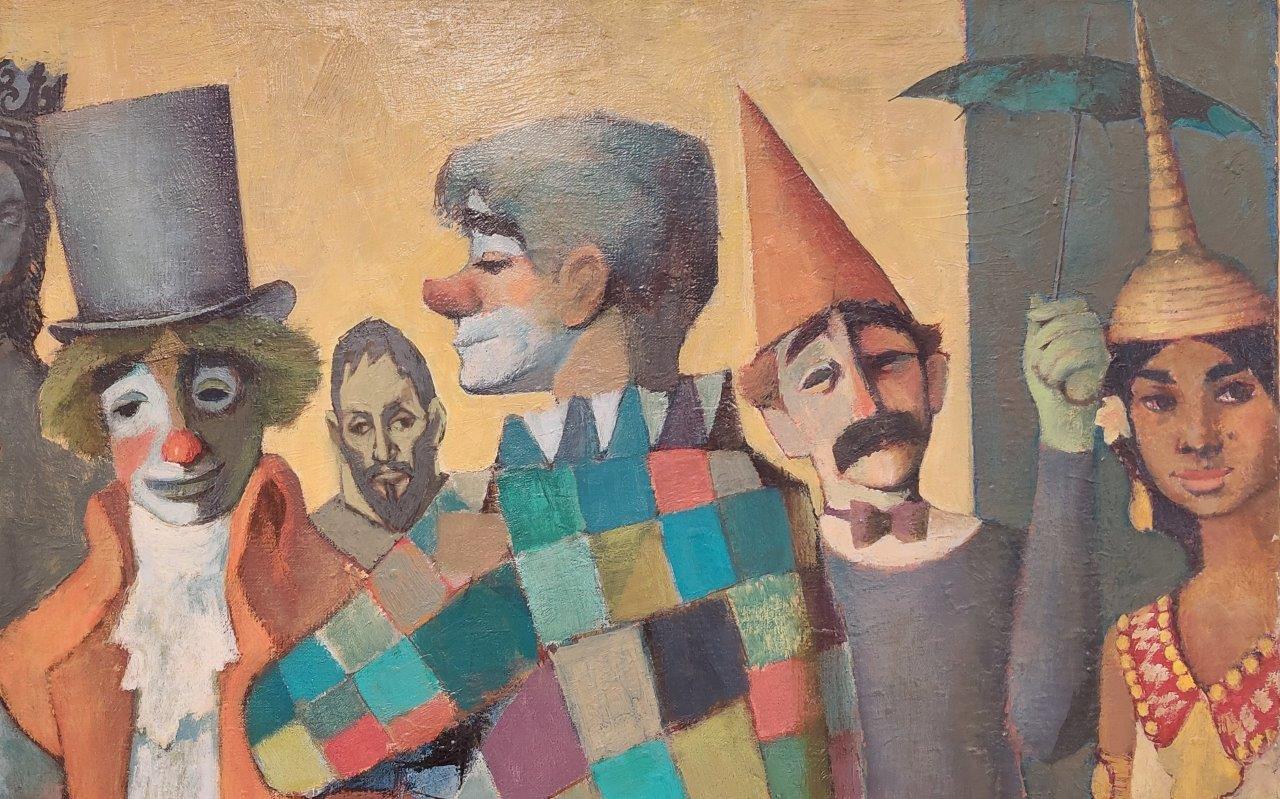
The retrospective exhibition of painter Vladimir Udatny presents more than one hundred works, predominantly oil paintings, drawings and monotypes, together with two sculptures. The exhibition was prepared with the support of the Udatny family, in particular the artist’s son Arno, who made his father’s legacy available to the Museum, including unpublished writings, art criticism and paintings from the family collection. The exhibition also features works from the collection of the City Museum of Rijeka, as well as works on loan from the Museum of Modern and Contemporary Art in Rijeka, the Museum of Fine Arts in Osijek, the National Museum of Modern Art in Zagreb, the Maritime and History Museum of the Croatian Littoral Rijeka, the Gallery of Fine Arts of the National Museum Zadar, the Vukovar Municipal Museum and the City of Rijeka, along with works from the Udatny family collection and other private collections. Vladimir Udatny arrived in Rijeka in 1951 and remained in the city for the rest of his life. He became one of the most prominent names in Rijeka’s 20th-century art scene. He participated in exhibitions locally, nationally and abroad, and spent several extended periods in Switzerland. Udatny left behind an impressive body of work, distinguished by a bold geometrisation of landscapes and the bustle of urban life, as well as striking series devoted to harlequins and abstraction. Alongside his significant artistic achievements in oil painting, he also accepted a number of commissions to decorate public spaces. Although some of these works are particularly accomplished, such as the fresco in the foyer of the Fenice Theatre, these commissions primarily provided financial security rather than personal artistic fulfilment. Nevertheless, this was an established artistic practice, no different from that of other prominent painters who worked in the Kvarner region, including Venucci, Prica and Murtić. Through the retrospective exhibition and its accompanying catalogue, the aim is to place Udatny’s work within the context of the 1960s and 1970s and to encourage a reassessment of the place his oeuvre occupies in the history of Croatian art.
The exhibition is on view from 21 March to 31 May 2025.

